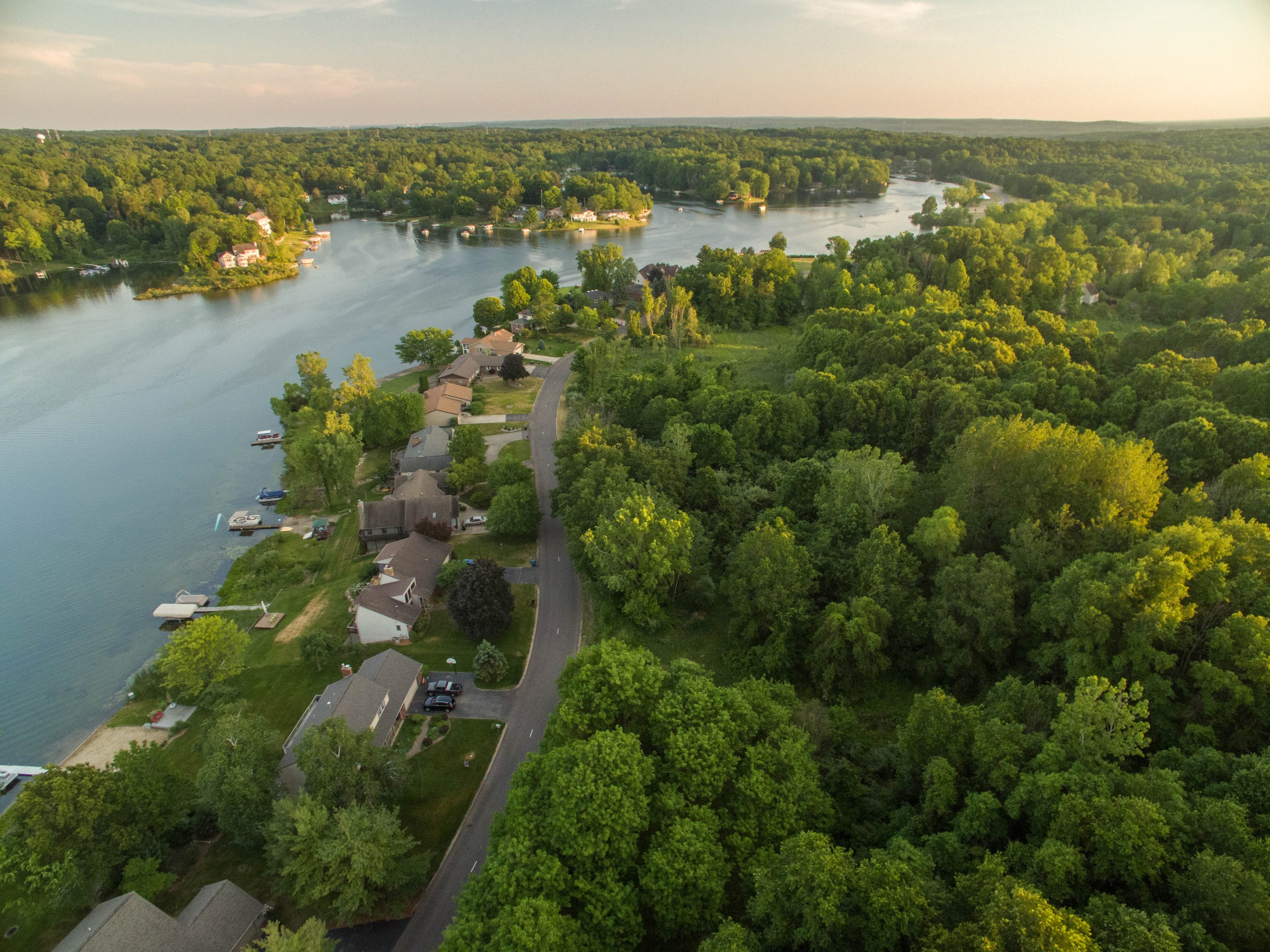
Nearly every waterfront deal I work has the same moment in it. Someone falls for a place, and then asks a question nobody has answered for them: can I put a dock there? Can I put two? Does the neighbor's lift get to sit twelve feet off my shoreline?
The answers come out of riparian law, and in Michigan that is mostly judge-made doctrine rather than one tidy statute you can look up. Here is the practical version.
What "riparian" actually means
A riparian owner is someone whose land touches the water. In Michigan that status carries a bundle of rights that a back lot a hundred feet up the road does not get, including the right to reach the water from your own land, to build a dock out to usable depth, to moor a boat there, and to use the surface of the whole lake.
Two things people get wrong about this:
- Riparian rights attach to the land, not to the person. They transfer with the deed, and they can be limited by what is recorded against that deed.
- Having lake frontage is not the same as having unrestricted use of it. Recorded easements, plat dedications, and association covenants all sit on top of riparian law and routinely narrow it.
Who owns the bottom of the lake
On an inland lake in Michigan, the riparian owners own the bottomlands — the land under the water — out toward the middle. The lake bottom is divided among the surrounding owners rather than belonging to the state.
How those lines get drawn is where it gets interesting, because a lake is not a rectangle. Michigan courts apportion bottomlands in a way that is meant to give each owner a fair share of the bottom relative to their frontage, and on a curved or irregular shoreline the resulting line often does not run straight out perpendicular from your beach. On a cove or a point, your dock line and your neighbor's can converge in ways neither of you would guess from looking at the shore.
This matters the moment two docks are close together, which on a busy lake is most of the time. If a dock placement looks tight, that is a survey question, not a conversation-over-the-fence question.
When you need a permit
Michigan regulates work in and along inland lakes under Part 301, Inland Lakes and Streams, of the Natural Resources and Environmental Protection Act (1994 PA 451). The permitting agency is EGLE, the Department of Environment, Great Lakes, and Energy.
In broad terms, a seasonal dock of ordinary size is generally treated as exempt, while the following typically need a permit:
- Dredging, including "just cleaning out" a weedy boat slip
- Placing fill below the water line
- Seawalls and most permanent shoreline armoring
- Permanent structures and unusually large or long docks
- Boat basins, channels, and marine railways
The exemptions have conditions attached, and they change. Do not take a seller's word that something was "grandfathered." Ask EGLE directly, and ask whether a permit exists for what is already there — an unpermitted seawall becomes your unpermitted seawall at closing.
Back lot owners and shared access
This is the single most common source of lake disputes around here, and it is worth understanding before you buy on either side of it.
Many lake plats include an access easement or a dedicated park strip giving non-waterfront lots a way to the water. What those back lot owners may actually do there depends entirely on the language of the recorded instrument. An easement for "access to the lake" is not automatically an easement to install a dock, moor a boat overnight, or park a trailer. Michigan courts read these documents closely, and the outcome usually turns on the exact wording and on what has historically been done.
If you are buying waterfront, you want to know who else has a recorded right to use your shoreline. If you are buying a back lot because of the access, you want to know in writing what that access includes — before you pay for it.
What to check before you write an offer
- The title commitment, in full. Read every recorded easement and restriction, not just the summary. This is where dock rights live or die.
- A survey, if dock placement matters to you. Especially on a point, a cove, or a narrow lot.
- Permit history with EGLE for any seawall, dredging, or permanent structure already in place.
- The association's recorded documents, if there is one. See the post on associations and assessments.
None of this takes long. All of it is much cheaper before closing than after.
If you want a hand with this
I grew up in Plainwell and I have been on and around these lakes my whole life. If you are looking at a waterfront home and want someone to actually check the easements, the permits, and the dock situation before you write an offer, call or text me at (269) 247-6868, or send me a note. If you already own on a lake here and just want to know what things are selling for, every lake I track is at jobrienhomes.com/lakes.

Jason O'Brien
Realtor® in Southwest Michigan. 10+ years selling homes, solving problems, and answering the phone.
Free Buyer's Guide
Learn what to look for in Southwest Michigan homes.
I'll respond within 24 hours. No spam, just honest service.