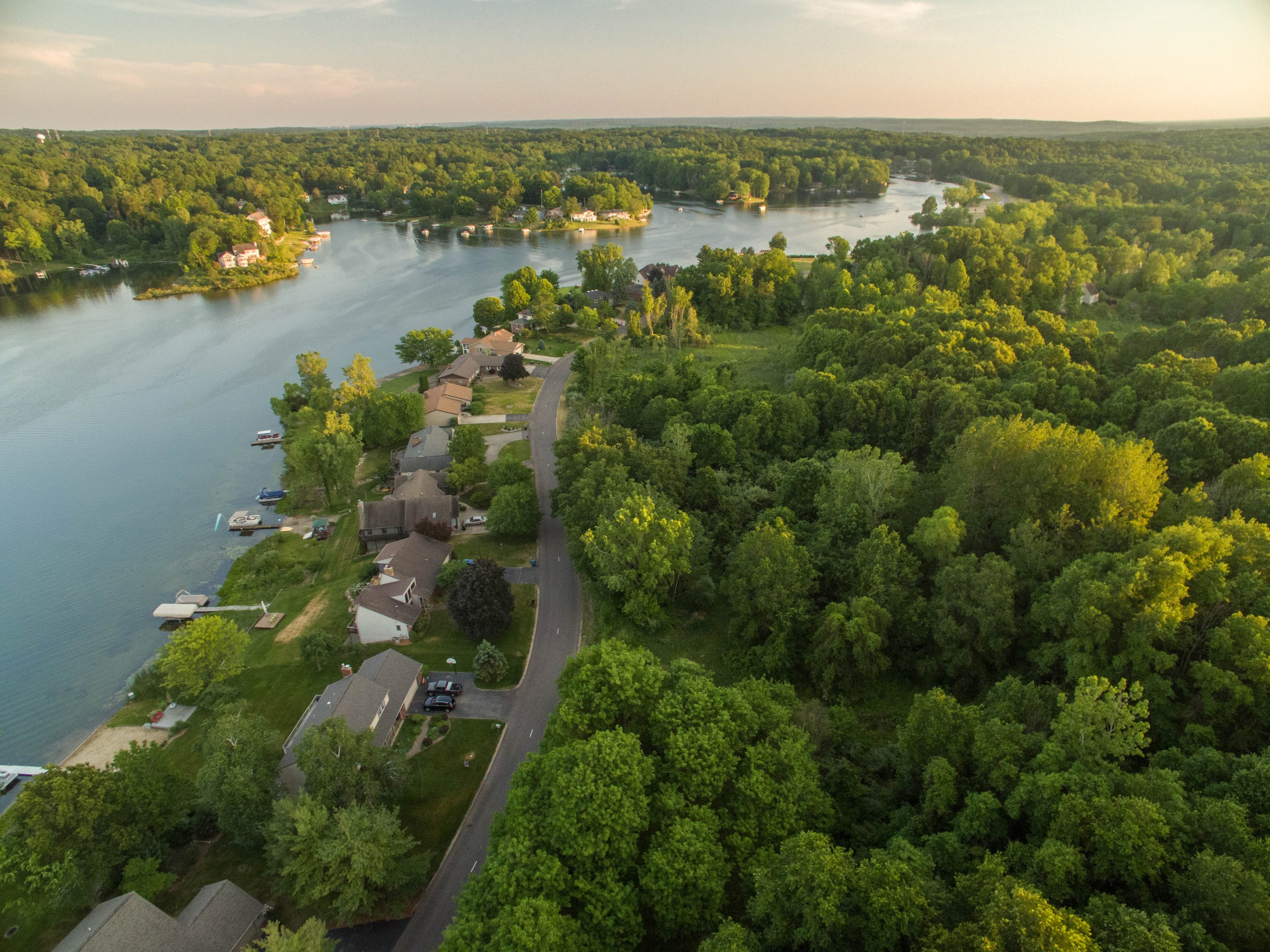
Buyers who have owned on an inland lake sometimes assume Lake Michigan frontage works the same way, only bigger. It does not. The ownership rules are different, the permitting is different, and the shoreline itself moves in a way that no inland lake around here does.
Who owns the beach
On an inland lake, the surrounding owners own the bottomlands. On the Great Lakes, the bottomlands below the ordinary high water mark are held by the State of Michigan in public trust.
The Michigan Supreme Court addressed what that means for beach walking in Glass v. Goeckel in 2005, holding that the public may walk along the shore below the ordinary high water mark. Your deed may run to the water, but the strip below that mark carries a public right of pedestrian passage.
This surprises people, and it is better to be surprised now than at a closing table. It is not a defect in a particular home — it is how the Great Lakes shoreline works everywhere in Michigan.
Where the ordinary high water mark actually is
It is a legal and physical concept rather than a line someone painted, identified by where the water has left a lasting mark on the land — a change in vegetation, in soil, in the character of the bank. On a wide, flat beach in a low-water year, the ordinary high water mark can sit a surprising distance landward of where the water is sitting the day you tour.
If the size of your usable private beach is material to your decision, that is worth a conversation with a surveyor familiar with Great Lakes frontage, not an eyeball estimate on a calm day in August.
Permits are a different chapter
Work along Great Lakes shoreline falls under Part 325, Great Lakes Submerged Lands, of the Natural Resources and Environmental Protection Act — not the Part 301 rules that govern inland lakes. Seawalls, revetments, groins, and most permanent shoreline protection need authorization from EGLE.
Michigan also designates high-risk erosion areas along parts of the shoreline, which carry construction setback requirements administered by EGLE. Whether a given parcel sits in one is a specific, checkable fact. Check it. A buildable-looking lot and a lot you can actually build on are not always the same lot.
Water levels move, and so does the shore
Lake Michigan water levels run in long cycles measured in years, not seasons. The lake set record highs around 2020 and had been near record lows within the preceding decade. That swing is not unusual — it is the normal behavior of the system.
The practical consequence is that beach width is not a fixed feature of a home. A listing photo showing a generous beach may have been taken in a low-water year. The same home in a high-water year can have waves against the bank.
Two things to do about it:
- Look at the long record. The Army Corps of Engineers, Detroit District publishes Great Lakes water level data going back over a century, plus forecasts.
- Look at historical aerials. County GIS and aerial imagery from different years will show you how that specific stretch of bank has behaved. Bluff recession is visible if you compare across a decade.
Before you write an offer
- Confirm whether the parcel is within a designated high-risk erosion area
- Get the permit history for any existing shoreline structure
- Have the ordinary high water mark located if beach size matters to you
- Look at aerials from a high-water year, not just the listing photos
- Ask what the bank is made of — sand, clay, and glacial till behave very differently
Current inventory and the closed-sale record for the shoreline I track are on the Lake Michigan page.
If you want a hand with this
I grew up in Plainwell and I have been on and around these lakes my whole life. If you are looking at a waterfront home and want someone to actually check the erosion designation and the permit history before you write an offer, call or text me at (269) 247-6868, or send me a note. If you already own on a lake here and just want to know what things are selling for, every lake I track is at jobrienhomes.com/lakes.

Jason O'Brien
Realtor® in Southwest Michigan. 10+ years selling homes, solving problems, and answering the phone.
Free Buyer's Guide
Learn what to look for in Southwest Michigan homes.
I'll respond within 24 hours. No spam, just honest service.